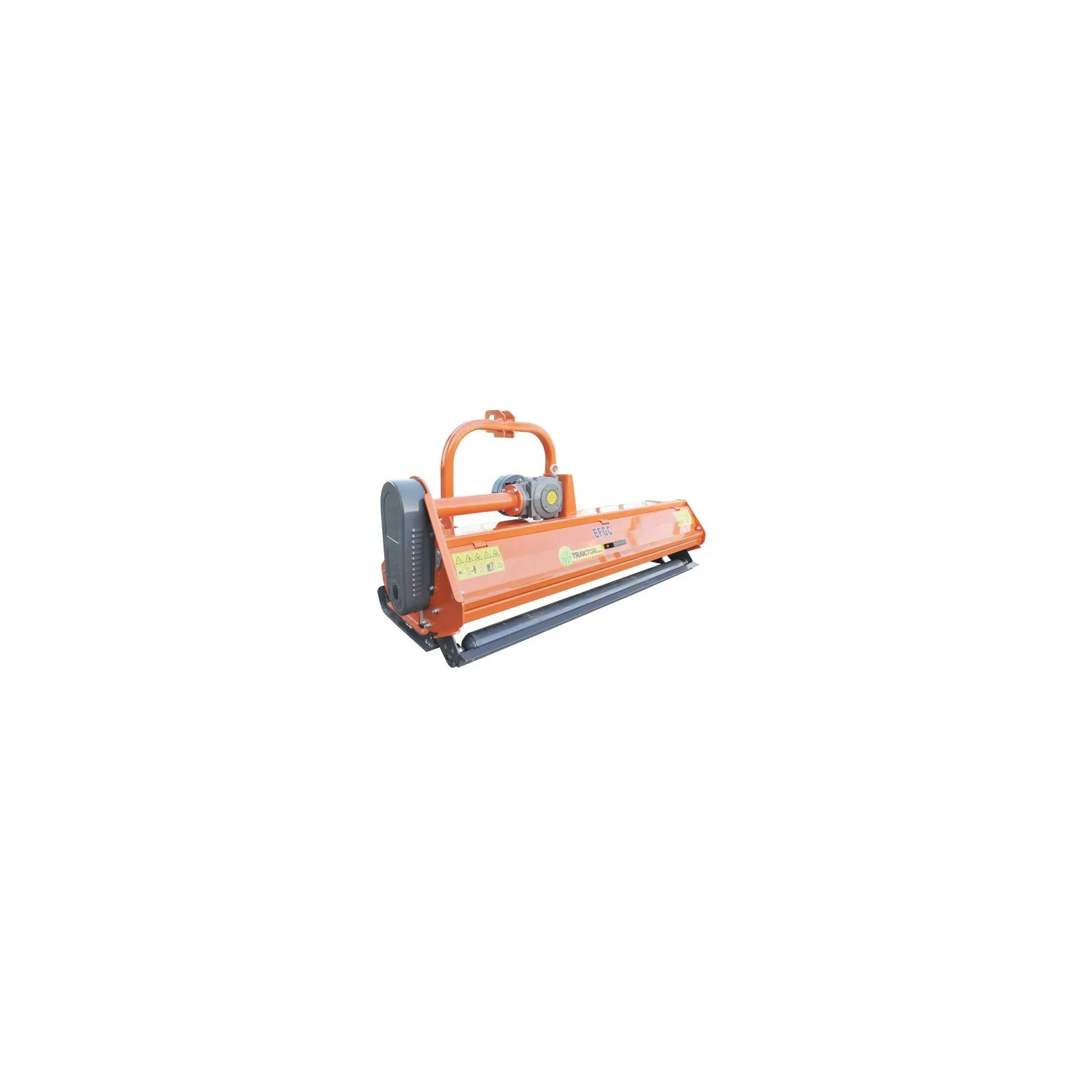
It is equipped with heavy hammers that work very well in wasteland. The large gear allows you to connect the mower to a tractor with higher power.
Distinguishing features:
arched mounting
even stronger structure
better bearings
All this to meet the expectations of the most demanding customers.
Application:
clearing all types of wasteland,
mowing roadsides,
mowing green areas in cities
maintenance of pastures, meadows, recreational areas and bushes for cleaning purposes
mowing green areas in parks
as a cleaning machine in orchards and nurseries
Advantages:
can be easily used in urban areas because the number of flying stones and their impact are greatly limited,
when caring for lawns, there is no need to collect mulched grass if this procedure is repeated quite often,
it can also cope in unkempt areas with more stones, branches and other obstacles,
cut green material quickly turns into humus, and old grass does not grow back so quickly,
has double protection against damage to the gear: the hammers bounce off a stable obstacle, the belts on the pulleys slip if there is too much resistance,
the gearbox has a one-way clutch
simple construction ensures reliability and low repair costs
Technical data:
gear type - angular gear with clutch
equipped with a reinforced angle gear with a clutch,
cutting elements: 32 hammers mounted on a 16 mm screw, weighing 700 g, possibility of purchasing "Y" knives,
adjustable cutting height,
very good mowing quality.
Specifications
Condition
New
So
Geograss
Minimum required tractor power (HP HP PS)
80
Maximum operating speed (km/h)
10
PTO / PTO
540 (rpm)
Weight (kg)
386
Overall width (mm)
2100
NEXT DOOR
3 point
Color
Orange
Yield (ha/h)
2.0
Number of V-belts
4
Number of beaters (pcs.)
32
Reviews of EFGC 200M..
8773
This product has no reviews yet.
We collect reviews from verified Customers after the purchase of the product.
Write your review
Review form will be here
Questions & Answers
How to choose a plow for the power of my mini tractor?
Correct selection of a plow for the power and weight of the tractor is key to effective plowing and protection of the drive system against overload. It is assumed that for each plow body (furrow) with a width of approx. 20-25 cm, a mini tractor should have a power of 8 to 12 HP, depending on the soil compactness. For machines with 15-20 HP, the optimal solution is usually a single-furrow plow, while units over 22-25 HP with 4x4 drive can handle a light two-furrow plow. It is also important to set the plowing depth and the pull point, which allows for maintaining a straight path without the need for constant steering correction. Robust agricultural equipment from brands such as Geograss or TRX has been designed to minimize the resistance offered by the soil, which directly translates into lower fuel consumption. Remember that a plow that is too large will cause excessive wheel slip and may lead to premature clutch wear. Before purchasing, always check the three-point linkage (TUZ) lifting capacity of your tractor to ensure the machine safely lifts the tool in the transport position.
How to choose a plow for the power of my mini tractor?
Correct selection of a plow for the power and weight of the tractor is key to effective plowing and protection of the drive system against overload. It is assumed that for each plow body (furrow) with a width of approx. 20-25 cm, a mini tractor should have a power of 8 to 12 HP, depending on the soil compactness. For machines with 15-20 HP, the optimal solution is usually a single-furrow plow, while units over 22-25 HP with 4x4 drive can handle a light two-furrow plow. It is also important to set the plowing depth and the pull point, which allows for maintaining a straight path without the need for constant steering correction. Robust agricultural equipment from brands such as Geograss or TRX has been designed to minimize the resistance offered by the soil, which directly translates into lower fuel consumption. Remember that a plow that is too large will cause excessive wheel slip and may lead to premature clutch wear. Before purchasing, always check the three-point linkage (TUZ) lifting capacity of your tractor to ensure the machine safely lifts the tool in the transport position.
What are the types of rototillers and which one will be best for my garden?
The choice of the right rototiller depends primarily on the type of planned work and the condition of the soil in your garden. A standard mounted rototiller installed on a three-point linkage (TUZ) is ideal for seasonal soil loosening and mixing with fertilizers. If you are establishing a new lawn on difficult, weed-infested terrain, the best choice will be a stone burier (separation rototiller), which, thanks to the reverse rotation of the blades, buries stones and plant residues deep under a layer of clean, sifted soil. For professional orchardists, a side rototiller (inter-row) is dedicated, allowing for precise cultivation right next to tree trunks. Regardless of the model, the heart of the machine is a durable angle gearbox and hardened cutting blades, which must be regularly checked for sharpness and tightness. The correct PTO speed (standard 540 rpm) ensures an optimal granular structure of the soil, which promotes better aeration and water retention. By investing in high-quality cultivation machinery, you can be sure that the preparation of the ground for crops will be fast, thorough, and will not excessively strain your compact tractor.