Polski
 English
 Deutsch
 Čeština
 Slovenčina
 Español
 Français
Narrow walkways between buildings, parking areas in front of a business, and long access roads each require a different approach to snow removal. Factors such as available maneuvering space, the volume of snow to be moved, and the designated area for snow storage all vary. Therefore, a snowplow should be selected based on both the tractor and the specific terrain where it will be used. Learn when a straight-blade plow is the best choice, and when a V-plow (or "arrow" plow) with adjustable wings might be more suitable.
Straight-blade plow – for routine snow clearing
A straight-blade plow consists of a single moldboard. Depending on how it is positioned, it can push snow directly ahead of the tractor or direct it to either the left or right side. This solution is ideal for the regular clearing of driveways, passageways, and open areas where snow can be piled up along the edges.
Our product range includes straight-blade plows with either manual or hydraulic adjustment.
The choice depends primarily on how often you need to adjust the position of the plow blade while working.
The 4FARMER ASM150 with a 2-in-1 front loader (TUR) / three-point hitch (TUZ) mount has a working width of 150 cm, a rubber cutting edge, and manual angle adjustment. It is designed for tractors with a minimum power of approximately 25 HP. This model is a good choice if you typically perform most of your passes using the same plow setting and only occasionally need to change the direction in which the snow is pushed.
If you frequently need to change the working direction, the 4FARMER ASH150 with a 2-in-1 front loader (TUR) / three-point hitch (TUZ) mount will be more convenient. It also has a working width of 150 cm but features hydraulic adjustment, allowing you to change the plow's position directly from the operator's seat. The model weighs 120 kg and requires a tractor with a minimum power of approximately 25 hp.
A straight snowplow with hydraulic angling is a good choice if you need a simple design and the ability to conveniently change the direction in which snow is pushed.
Vario V-plow – multiple settings for various tasks
The Vario plow features two adjustable blade sections. By changing the position of the wings, you can adapt how the snow is moved to suit the specific task at hand.
Our 4FARMER Vario 180 cm model (includes mounting plate) can be set up in the following configurations:
-
V-configuration – for pushing snow to both sides;
-
Angled configuration – for directing snow to the left or right;
-
Scoop configuration – for gathering snow in front of the plow and preventing it from spilling out to the sides.
Two hydraulic cylinders handle the adjustment of the wings, while a solenoid valve allows for control via a single joystick. This version weighs 220 kg and requires a tractor with a minimum power of 35 hp.
The Vario is worth considering if, in a single outing, you need to clear paths, clean up parking areas, and move snow to a designated location. The ability to reconfigure the blade allows you to adapt the plow for these different tasks without needing to change attachments.
Which snowplow should you choose for clearing sidewalks?
When working on sidewalks, the overall dimensions of the entire setup are the most important factor. Before selecting a snowplow, measure the narrowest section of your route and take into account any posts, trees, fences, and the space required for maneuvering.
Also, consider where you intend to pile the snow. If you plan to push the snow to one side along the entire route, a straight-blade plow may be perfectly adequate for your needs. If you anticipate frequent adjustments to the blade angle, a hydraulic control system will be very useful. If you also need to push snow to both sides or gather it in front of the machine, a Vario (V-plow) model is a great choice.
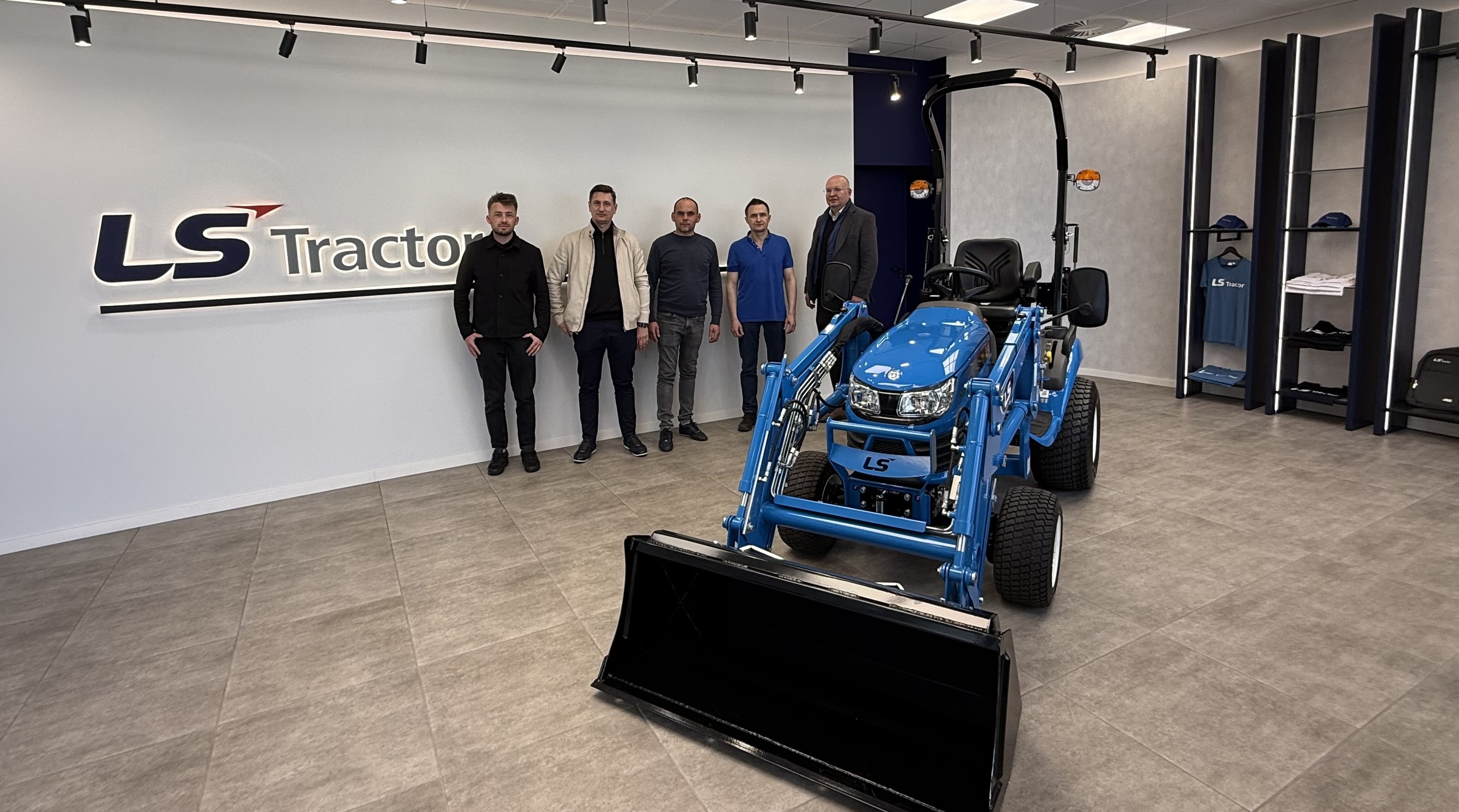
We configure LS Tractor units for a variety of winter tasks. The LS XJ25 can be equipped with either the SBH140 straight-blade plow or the Vario 150 model, provided the appropriate mounting hardware and control systems are installed. This allows you to tailor your snow-clearing method to the specific requirements of your route.
The 4FARMER Vario 150 cm (for front three-point hitch) weighs 169 kg and is designed for tractors with a minimum power output of approximately 20 hp. Operation requires a front three-point hitch and a properly configured hydraulic system, including a three-section control valve with a "float" position. When assembling the equipment set, we therefore assess the tractor’s existing features as well as any additional equipment that may be required.
Which snowplow is best suited for parking lots and open areas?
When clearing snow from a parking lot, the surface area alone is not enough to determine the right snowplow. Other important factors include the layout of parked vehicles, traffic islands, curbs, gates, and the designated area for snow storage.
For an open area—where it is possible to make long passes and push snow in a single direction—a wider, straight-blade snowplow is worth considering. 4FARMER ASH200 with a 2-in-1 front-loader/three-point hitch (TUR/TUZ) mount features a 200 cm working width, hydraulic adjustment, and a rubber cutting edge. It requires a tractor with a minimum power output of approximately 30 HP.
In parking areas with numerous obstacles, various "Vario" (adjustable-angle) settings can prove highly useful. The choice of configuration should depend on your operational plan, including the direction of travel, available maneuvering space, and the desired method for moving the snow.
For winter grounds maintenance, we also recommend the following setup: an LS MT3.40 tractor equipped with a 4FARMER Vario 150 snowplow and an M320 "butterfly" spreader (with a municipal-use attachment).
Such a setup allows for combining snow clearing with surface gritting.
A larger tractor does not always require a wider snowplow. Narrower equipment may be better suited to the layout of the paths and the limited space between obstacles.
Which snowplow is best for access roads?
When dealing with an access road, check its width, curves, passing areas, and entrances to properties. Also, determine whether snow can be pushed to both sides or only to one shoulder.
For regular clearing in a single direction, consider a straight snowplow with hydraulic angle adjustment. A "Vario" (V-plow) model is useful if you need to adjust the blade configuration in various ways along the route.
Keep in mind that when the plow is angled, the cleared path becomes narrower than when it is set straight. Therefore, the nominal width of the blade should not be equated with the actual clearing width in every position.
When selecting a setup, consider both the clearing width in front of the tractor's wheels and the ability to maneuver freely along the route. Environmental conditions also matter: wet snow, inclines, and the accumulation of snowbanks along the sides place greater demands on the machinery.
What should you check before buying a snowplow?
The selection process begins with the tractor, the terrain, and the intended method of operation. Before making a purchase, it is helpful to have the following information ready:
-
Tractor model and specifications. Engine power is one of the key criteria.
You must also take into account the machine's weight, traction, lifting capacity, and permissible load limits.
-
Type of mounting. A front three-point hitch (TUZ), a loader quick-attach frame (Euro-hitch), or a mounting plate requires proper preparation. Simply having a "loader" (TUR) or "three-point hitch" (TUZ) designation does not guarantee compatibility with every tractor.
-
Available hydraulics and controls. Check the hydraulic connections, control valves, the presence of a "float" position, and any electrical power supply required by the plow's equipment.
-
Width and layout of paths. Consider the narrowest points, turns, and the space required for maneuvering.
-
Type of surface. A rubber cutting edge helps reduce the risk of damaging the ground, but proper height adjustment and careful operation near obstacles are equally important.
-
Snow storage area. It is best to plan this before the season begins, taking into account subsequent snowfall and ensuring access to gates, entrances, and parking spaces.
Straight plow or V-plow – which one should you choose?
A straight plow is recommended for regular snow clearing where the snow is pushed in a consistent, predictable direction. A V-plow (Vario) is better suited for situations where you need to change how the snow is directed or when working on varied routes.
On sidewalks, the priority is the size of the equipment and its maneuverability. In parking lots, the focus should be on the layout of obstacles and where the cleared snow will be piled.
For access roads, ensure an adequate clearing width and the ability to push snow onto the verges.
Let us help you put together the right equipment for winter operations. Provide us with your tractor model, its current configuration, and the type of terrain you need to clear. Photos and the width of the narrowest passage you’ll encounter will also be very helpful. At Traktor.com.pl, we will assist you in selecting the ideal snowplow, mounting system, and control setup tailored to your specific requirements.